Image Source: Firstpost
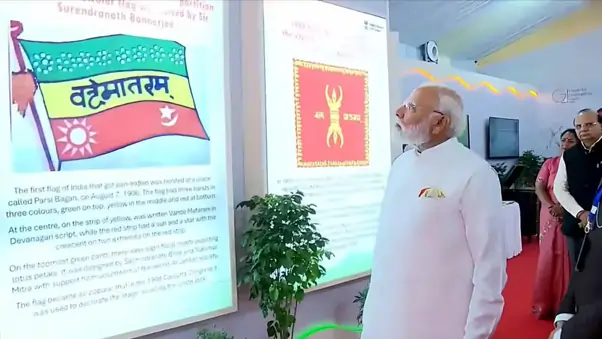
Some years ago, a perceptive British writer observed that his country was sharply polarised between the ‘somewhere’ people and those who could be dubbed the ‘anywhere’ people. In a curious sort of way, the clash between those who saw themselves as grounded in India’s distinctive nationhood and those whose sense of modernity stretched into multiculturalism and post-nationalism was evident during last week’s parliamentary discussion to commemorate 150 years of Vande Mataram.
To those uneasy with the Modi government’s assertive nationalism, there was no earthly reason why valuable parliamentary time was expended on marking the landmark anniversary of the Constitution-decreed ‘national song’. Judging by their displeasure, a grand, possibly well-choreographed function in one of Delhi’s grand sarkari venues may well have sufficed.
Judging by the somewhat supercilious intervention of Congress MP Priyanka Gandhi, the debate was occasioned by the Prime Minister’s waning confidence in his own governance and to divert attention from the more pressing problems confronting India. In all likelihood, those with Nehruvian mindsets would have considered exploring the fascinating by-lanes of the nationalist movement as of a priority than articulating the mismanagement of India’s largest airline.
In the new history that has been dished out to generations of Indians since the Left takeover of education in the 1970s, Vande Mataram, while undeniably the most inspirational mantra of the freedom struggle, also carried Bankim Chandra Chatterjee’s more problematic baggage. The entire song, apart from being couched in difficult language, was also seen to be too full of Hindu imagery to be acceptable to Muslim and secular sensibilities. This mattered to Jawaharlal Nehru who, in the words of Nirad Chaudhuri, was “usually repelled by anything pronouncedly Hindu”.
Although the trouble vexing the Congress during the second half of the 1930s was a nagging sense of a nation not yet fully defined by the Congress narrative, the compromise of adopting Vande Mataram as the ‘national song’ rather than the ‘national anthem’ was meant to be a solatium prize of nationalism without its sharper edges. The Constituent Assembly chairman’s ruling on January 24, 1950, like the Constitution’s embarrassing Directive Principles that called for cow protection, prohibited or allowed an uncomfortable civic choice: there was a quiet hope that in time Vande Mataram would steadily become decorative.
This hasn’t happened, as evident from its popularity in flag-waving occasions.
It is interesting that the BJP rather than the Congress has always taken the lead in trying to make Vande Mataram India’s parallel national anthem. The first initiative came from BJP MP Ram Naik who took the initiative in 1992 to ensure Vande Mataram was sung at the end of each parliamentary session. The suggestion was endorsed by PM P V Narasimha Rao whose personal attachment to the song overshadowed the objections.
However, by trying to accommodate Jinnah’s objection to the ‘reliability’ of Vande Mataram, the Congress Working Committee resolution of 1935 failed to stem the tide of Muslim separatism. Eighty years later, Pakistan had become a reality.
The lesson that BJP leadership drew from this controversy is that minority appeasement invariably leads to escalating demands and a corresponding emasculation of nationhood. The linkage between the partition of India and the ‘national song’ may not be scoffed at.
Even if the full song is unlikely to be insisted upon and A R Rahman’s catchy version will continue to be mistaken for the real thing, the Vande Mataram debate is likely to be a landmark. The forthright speeches of the three top ministers of the government have indicated without a shred of doubt that the post-Independence squeamishness associated with the mantra Sri Aurobindo evocatively described as the “religion of patriotism” has been finally junked.
Vande Mataram will remain a metaphor for national pride, just as it was 150 years ago.
Courtesy: The Times of India
Author